Saturday, May 28, 2011

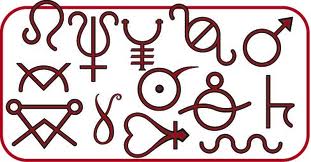
Alchemy Symbols


Friday, May 13, 2011

Frater Achad's Alchemical Pedagogy

"Unto you, O my Son, in whom that Fire burns, I would be as a bellows to fan the Flame into a great burning which shall illume the Darkness wherein thou walkest; so that from a flickering rushlight thou mayest become as a Lamp of Pure Oil, and that thy Lamp mayStar. shine forth as an Ever-burning Star of Hope to thy fellow men."
I.N.R.I. De Mysteriis Rosae Rubae et Aurae Crucis

Hugh Urban on Paracelsus--Imagination, Magic and Alchemy

Like Ficino and Bruno, Paracelsus believed that magic worked primarily through the imagination, which is not mere illusion or fantasy (phantasia) but a spiritual force that has real effect in the physical world. "Man... is altogether a star. Even as he imagines himself to be, such he is, and he is that also which he imagines. If he imagines fire, there results fire; if war, there ensues war... the imagination is itself a complete sun." Indeed, Paracelsus describes the imagination as a kind of "seminal power," which impresses the "seeds" of the magician's will onto external objects: "God planted the seed in all its reality and specificity deep in the imagination of man.... If a man has the will, the desire arises in his imagination and the desire generates the seed." Imagination is, again, closely tied to sexual desire; thus, a woman can deeply inform the nature of a fetus, bearing children "similar to her imaginations." Conversely, a woman who is overly lustful or unchaste can project dangerous things out of her imaginations, such as incubi, succubi, and even plague. It is through this power of imagination, moreover, that the alchemist makes the physical act of transmuting minerals a spiritual act, through which he himself is transformed, purified, and reborn as a spiritual being: "imaginatio is the active power... of the higher man within.... During this work man is 'raised up in his mind.' ... While the artifex heats the chemical substance in the furnace he himself is morally undergoing the same fiery torment and purification.

This model of alchemy as a spiritual, but also highly "erotic" art and this view of the imagination as a force of active magical power would both have a formative influence on most modern forms of sexual magic.
Hugh Urban, Magia Sexualis

Wednesday, May 11, 2011

Summary of Merkur's "Methodology" paper

Dan Merkur’s “Methodology and the Study of Western Spiritual Alchemy,” was first presented at the 1999 Western Esotericism Consultation Session of the American Academy of Religion. According to Dr. Merkur’s thesis, the view that different alchemical recipes are to be read simultaneously on the metallurgical and the mystical levels and that the transmutation of base metals into gold was isomorphic with an ecstatic process of mystical transformation, is false. The paper discusses the original assumption of isomorphism, including that of Carl. G. Jung, and then proceeds to establish, in agreement with the historian John Read, Paracelsus as the initiator of an alchemy possessing both chemical and spiritual ingredients. Dr. Merkur then discusses some of the assumptions of spiritual alchemy, including the use of psychoactive drugs and scrying stones “to experience the spiritual nature of the sublunar and ethereal realms, respectively.” Furthermore, in the light of the writings of the Welsh alchemist Thomas Vaughan (ca. 1621-1665), there is every reason to assume that alchemists “also adapted the kabbalah’s procedures for incarnating souls during marital sex.”

http://www.theohistory.org/description-of-issues/descript_of_issues_v8.html